The economic recovery of the Great Recession has been almost
imperceptible to most Americans. On a per capita bais, real GDP per
Capita grew by 11.55% in the past twelve years - or roughly a compounded
annual average growth rate of only 0.91% per annum. This is far less
than the so-called "Hindu Rate of Growth" threshold of 1.30% per annum. This growth rate is so slow that it is almost imperceptible.
In 2019, something extraordinary happened. Those who survived the Great
Depression in 1941 (twelve years after the onset of the Great
Depression) will be substantially better of than the survivors of the
Great Recession in 2019. Real GDP Per Capita for Great Recession
survivors would have grown by another anemic 0.91% per annum in 2019.
But for survivors of the Great Depression era, their incomes per capita
would have grown by an astounding 15.95% in just one year. Moreover, that
trend will only accelerate in the next two years. By 1943, Great
Depression survivors will be almost 34.48% richer than they were in 1941.
Can we expect the same for survivors of the Great Recession in the next two years? It's possible but not probable.
Search This Blog
Showing posts with label Hindu Rate of Growth.. Show all posts
Saturday, July 27, 2019
Tuesday, May 22, 2018
It's Official: The Current Economic Recovery is Now Much Slower Than That of the Great Depression
There's no doubt about it. The economic decline of the Great Depression was extremely severe. Nominal
GDP per capita decline by almost 50% during the Great Depression versus
a slightly more than 2% decline in Nominal GDP per capita during the
Great Recession. Eleven years after the start of the Great Depression, Nominal GDP per capita was still almost 10% lower. In the Great Recession, it is 27.01% higher.
However, economic growth rates during the Great Depression were much more robust than that of the Great Recession, both on an absolute basis and on a per capita basis.
In truth, the economic recovery of the Great Recession has been almost imperceptible to most Americans. On a per capita bais, real GDP per Capita grew by 7.66% in the past eleven years - or roughly a compounded annual average growth rate of only 0.67% per annum. This is far less than the so-called "Hindu Rate of Growth" threshold of 1.30% per annum. This growth rate is so slow that it is almost imperceptible.
In 2018, something extraordinary happened. Those who survived the Great Depression in 1940 (eleven years after the onset of the Great Depression) will be substantially better of than the survivors of the Great Recession in 2018. Real GDP Per Capita for Great Recession survivors would have grown by another anemic 0.67% per annum in 2018. But for survivors of the Great Depression era, their incomes per capita would have grown by an astounding 7.75% in just one year. Moreover, that trend will only accelerate in the next three years. By 1943, Great Depression survivors will be almost 56% richer than they were in 1940.
Can we expect the same for survivors of the Great Recession in the next three years? It's possible but not probable.
Previous Post: The American Rate of Growth
Great Depression vs. Great Recession
Thursday, March 15, 2018
The American Rate of Growth
The economic recovery of the Great Recession has been almost
imperceptible to most Americans. On a per capita bais, real GDP per
Capita grew by 7.11% in the past ten years - or roughly a compounded
annual average growth rate of only 0.69% per annum. This is far less
than the so-called "Hindu Rate of Growth" threshold of 1.30% per annum. This growth rate is so slow that it is almost imperceptible.
Sometime in 2018, if growth rates continue their current trend, something extraordinary will happen. Those who survived the Great Depression in 1940 (eleven years after the onset of the Great Depression) will be substantially better of than the survivors of the Great Recession in 2018. Real GDP Per Capita for Great Recession survivors would have grown by another anemic 0.69% per annum in 2018. But for survivors of the Great Depression era, their incomes per capita would have grown by an astounding 7.75% in just one year. Moreover, that trend will only accelerate in the next three years. By 1943, Great Depression survivors will be almost 56% richer than they were in 1940.
Can we expect the same for survivors of the Great Recession in the next three years? It's possible but not probable.
Tuesday, December 19, 2017
Recovery in the Great Recession Has Been Amost Imperceptible - Let Me Tell You Why!
The economic recovery of the Great Recession has been almost imperceptible to most Americans. On a per capita bais, real GDP per Capita grew by 6.71% in the past ten years - or roughly a compounded annual average growth rate of only 0.72% per annum. This is far less than the so-called "Hindu Rate of Growth" threshold of 1.30% per annum. This growth rate is so slow that it is almost imperceptible.
Sometime in 2018, if growth rates continue their current trend, something extraordinary will happen. Those who survived the Great Depression in 1940 (eleven years after the onset of the Great Depression) will be substantially better of than the survivors of the Great Recession in 2018. Real GDP Per Capita for Great Recession survivors would have grown by another anemic 0.72% per annum in 2018. But for survivors of the Great Depression era, their incomes per capita would have grown by an astounding 7.75% in just one year. Moreover, that trend will only accelerate in the next three years. By 1943, Great Depression survivors will be almost 56% richer than they were in 1940.
Can we expect the same for survivors of the Great Recession in the next three years? It's possible but not probable.
Tuesday, July 4, 2017
Great Depression vs. Great Recession GDP Growth Rates - Third Estimate of the First Quarter of 2017
Last Thursday, June 29, 2017, the Bureau of Economic Analysis released their third estimate of 2017's first quarter GDP growth rate: 1.40%. For the fourth quarter of 2016, GDP grew by 2.1%.
The economic recovery from the Great Recession has been downright sluggish, never taking off beyond the 3.00% growth rate that signals a robust economic recovery and always flirting with the 1.00% growth rate that signals a stalling economy.
On a nominal basis, the economy is 31% larger than what it was ten years ago. In real terms, it's just 13% larger.
On a per capita basis, real GDP grew by only 5.34% for the past ten years, for a compounded annual average growth rate of only 0.52% per annum - far less than the so-called "Hindu Rate of Growth" threshold of 1.30% per annum. This growth rate is so slow that it is almost imperceptible.
To top it all, the growth has not been evenly distributed. As of year-end 2015, Real Median Household Income stood at $56,516 or 1.58% below the Real Median Household Income of $57,423 in 2007 and 2.41% below that of 1999 ($57,909). Almost all the gains in the economy have been going to the upper echelons of US society.
Monday, March 3, 2014
The Pinoy Rate of Growth
The Indian economy has long been famous for the "Hindu Rate of Growth", which was characterized by a growth in GDP per capita of only one percent per annum - a rate of growth so slow that it was imperceptible to the general population. This growth was attributed to the "Licence Raj", the Government of India's protectionist and interventionist policies. The dismantling of the "Licence Raj" in 1991 with economic liberalization and reform has led to a considerable speeding up of per capita GDP growth. Growth in GDP per capita (in constant 2005 US $) for India has now averaged 3.08% per year for the last 52 years (from 1960 t0 2012), more than double the 1.49% annual average growth rate for the Philippines during the same period.
The Future:
Source: Worldbank.org
Pinoy Rate of Growth
Do we have our very own Pinoy Rate of Growth, wherein economic improvement has been so slow as to be imperceptible? Around 10% of our population would shout a resounding "Yes!" and have voted with their feet, moving to other countries to find work and, perhaps, happiness.
Despite the acceleration of growth of the Philippine economy, growth in GDP per capita (in constant 2005 US $) has averaged only 2.90% per annum for the last five years (2008 to 2012), forty percent lower than India's 5.09% average annual growth rate for the same period.
Although India is a large nation with a large economy, it has over a seventh of the world's population. As a result, its GDP is spread out over a billion people. This results in a per capita GDP that is much lower than the Philippines. So even if India is growing much faster on a GDP per capita basis, it will take decades for India to catch up to the Philippines.
India's per capita GDP (in constant 2005 US $) now stands at $1,086 as of 2012.
The Philippines' per capita GDP (in constant 2005 US $) is $1,430 as of 2012, almost a third larger than India's.
Improved economic performance of the Philippines, in terms of GDP per capita, has been a relatively recent development. Significant strides in the GDP per capita growth rate only came about with the last two Presidents.
As a result, many other nations have overtaken us in the past and many other nations probably will overtake us in the future.
President Diosdado Macapagal
President Macapagal's economic record, in terms of growth in GDP per capita (in constant 2005 US $), dwarfs that of the last four Philippine Presidents who succeeded him. Despite this, six other nations that had a lower GDP per capita (in current US $) when he took office, eclipsed him within one year (1962).
- Algeria
- Brazil
- Dominican Republic
- Ecuador
- St. Kitts and Nevis
- Tunisia
A significant devaluation of the Philippine Peso versus the US Dollar, from Php 2.02/USD in 1962 to Php 3.73/USD didn't help either.
When adjusted for inflation, no other nation overtook the Philippines in terms of GDP per capita (in constant 2005 US $) during his term.
President Ferdinand Marcos
Marcos loyalists like to point out that President Marcos economic performance was strong. But the truth of the matter was that our nation's decline accelerated under his regime.
In terms of nominal GDP per capita (current US $), at least seven other nations, including our ASEAN neighbor Thailand, overtook us during his 21 years of power:
- Swaziland (1969)
- Morocco (1970)
- Paraguay (1970)
- South Korea (1970)
- Botswana (1972)
- Tonga (1975)
- Thailand (1983)
In constant 2005 US $, at least three other nations overtook the Philippines in GDP per capita:
- Botswana (1975)
- Paraguay (1978)
- Thailand (1984)
President Corazon Aquino
Cory Aquino fared a little better than Marcos: no other nation surpassed the Philippines in terms of GDP per capita, both in current US $ or constant 2005 US $, during her term.
But Tita Cory ranks the lowest in terms of GDP per capita growth (in constant 2005 US $) among all the Philippine Presidents since 1961: a lowly 0.72% Compounded Annual Growth Rate (CAGR) during her term, lower even than her predecessor and nemesis, President Marcos (0.86% CAGR).
President Fidel Ramos
Despite undertaking a massive liberalization of the Philippine economy, particularly in the banking, power, and retail sectors, President Ramos' economic performance (1.28% in terms of constant 2005 GDP per capita CAGR) was better than that of Marcos (0.86% CAGR) and Cory (0.72% CAGR), but lower than that of Macapagal (1.78% CAGR).
During his tenure, two other nations overtook the Philippines in terms of nominal GDP per capita:
- Samoa (1994)
- Egypt (1997)
In terms of constant 2005 US $ GDP per capita, it was even worse: four other nations overtook the Philippines, including Indonesia, another ASEAN country:
- Indonesia (1993)
- Cabo Verde (1994)
- Bosnia and Herzegovina (1996)
- Egypt (1998)
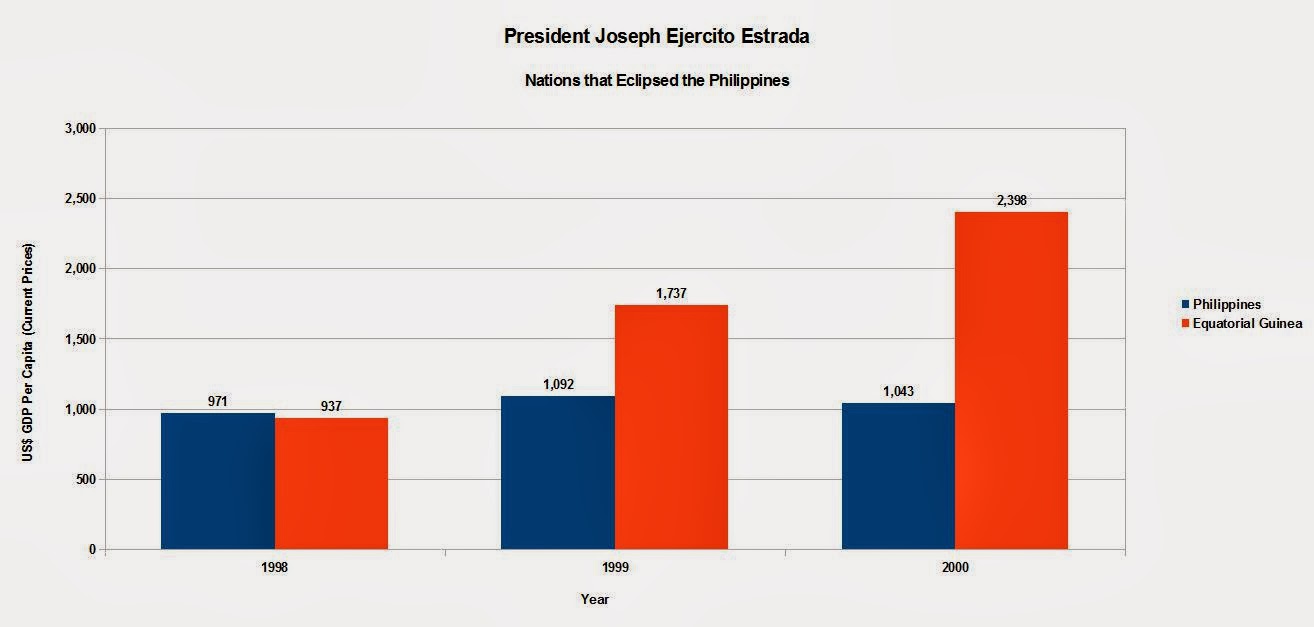
President Joseph Ejercito Estrada
Despite being ousted for corruption in 2001, President Estrada's economic tenure was at par with his predecessor Ramos, at least in terms of per capita GDP growth rates (1.28% CAGR), during his short tenure as our nation's President.
During his abbreviated term, one nation overtook the Philippines in terms of nominal GDP per capita: Equatorial Guinea (1999).
In terms of constant 2005 US $ GDP per capita, it was China (1999).
China is a special case, it has grown so fast in such a short time. In 1961, its nominal GDP per capita was $76, while Philippines nominal GDP per capita, at $267, was 3.5 times larger. For a long time, the thought that China could catch up with the Philippines was utterly inconceivable. Today, China's nominal GDP per capita stands at $6,091 - 2.35 times the Philippines nominal GDP per capita of $2,587!
President Gloria Macagal Arroyo
At a per capita GDP CAGR of 3.07% (in constant 2005 US $), GMA's economic performance was more than 70% better than her dad's economic performance of 1.78% CAGR and more than double that of her dad's four successors.
Still, four other nations fared much better and overtook the Philippines in terms of nominal GDP per capita during her ten-year administration:
- Indonesia (2003)
- Republic of Congo (2003)
- Angola (2004)
- Sri Lanka (2005)
In terms of constant 2005 US $ GDP per capita, three other nations surpassed the Philippines:
At a CAGR of 3.42%, Noynoy or PNoy's economic performance in terms of GDP per capita growth rates ranks the highest among all his six predecessor's, including that of his mother's.
Mongolia, it turns out, grew much faster, overtaking the Philippines in 2010 in nominal terms and in 2011 in constant terms.
The Future:
President Benigno Aquino III: 2013 to 2016
Under PNoy, the country has been growing at a rapid clip and exhibited one of the best economic performances in the ASEAN region in 2013.
But other countries are growing much, much faster and are projected to surpass the Philippines by the end of his term in 2016. In nominal terms, these countries are:
- Bolivia (2013)
- Papua New Guinea (2015)
In constant GDP per capita terms, no other countries are expected to surpass the Philippines.
President Jejomar Binay?
Who knows who will become President in 2016? If history is any guide, Binay, as VP, will take over from Noynoy in 2016, just as Erap did from Ramos in 1998.
Nevertheless, our country is locked in a certain growth trajectory. And if that growth trajectory holds, two other countries will overtake the Philippines in terms of nominal GDP per capita:
- Uzbekistan (2019)
- Vietnam (2022)
Yes, Vietnam, our bombed-out ASEAN rival, that only emerged from a debilitating war with the United States in 1975, could overtake the Philippines in nominal GDP per capita terms by 2022!
In constant 2005 US $ GDP per capita, no other country is expected to overtake the Philippines during Binay's (or whoever the next President is) term.
President Kris Aquino?
Projecting way, way into the future is definitely a crap shoot. And who knows who will be President past Binay, if Binay ever gets elected. Given our voter's penchant for name recognition, it wouldn't be surprising to see another familiar name as the top honcho of the country. After all, we've already had two repeats in the last 52 years. So Kris Aquino is my best bet.
But at our country's current economic path of growth, another bombed-out war-torn ASEAN neighbor will surpass us, at least in nominal terms, by 2024: LAO PDR
Which brings us back to India. If current economic growth rates hold, even India will surpass us in terms of constant GDP per capita, by 2027.
Source: Worldbank.org
Subscribe to:
Posts (Atom)