Search This Blog

Showing posts with label GDP Per Capita. Show all posts

Wednesday, December 5, 2018

Maybe Filipinos Are Getting Richer, More Filipinos Are Studying in the USA as of 2017-2018

Maybe Filipinos are getting richer. More of them are studying in the USA. After almost eight years of declining enrollment, the number of Filipinos studying in the USA has started trending up. At 3,225 students, enrollment at US educational institutions is almost 12% higher than the bottom of 2015, when 2,886 Filipinos enrolled. This is still almost 24% below the 2008 peak of 4,225.


We are finally joining our ASEAN neighbors, particularly Vietnam, whose students are enrolling in US universities in ever greater numbers.


If Filipinos Are Getting Richer, Why Are There Fewer Filipino Students in the USA Every Year? - Updated as of 2016-2017

Monday, July 9, 2018

If Filipinos Are Getting Richer, Why Are There Fewer Filipino Students in the USA Every Year? - Updated as of 2016-2017

If Filipinos are getting richer, why are there fewer and fewer Filipino students studying in the USA every year?


 According to the latest Open Doors Report, the number of Filipino students studying in US Colleges and Universities, at 3,066 students in 2016, is even lower than what it was in the year 2000: 3,139 students. However, this is a 4.16% increase over the previous year's total of 2,886 students.

This runs counter to the trend in the ASEAN. Other ASEAN countries, particularly Vietnam, have been enrolling more and more of their students in US Colleges and Universities.


If Filipinos Are Getting Richer, Why Are There Fewer Filipino Students in the USA Every Year?


The Mysterious Decline of Filipino Students in the US

Friday, January 20, 2017

If Filipinos Are Getting Richer, Why Are There Fewer Filipino Students in the USA Every Year?

If Filipinos are getting richer, why are there fewer and fewer Filipino students studying in the USA every year?


According to the latest Open Doors Report, the number of Filipino students studying in US Colleges and Universities, at 2,866 students in 2015, is even lower than what it was in the year 2000: 3,139 students.

This runs counter to the trend in the ASEAN. Other ASEAN countries, particularly Vietnam, have been enrolling more and more of their students in US Colleges and Universities.


This happened despite a dramatic surge in Philippine GDP per capita in the last ten years.


So what happened?

The Mysterious Decline of Filipino Students in the US

Monday, April 11, 2016

The Mysterious Decline of Filipino Students in the US

There is a noticeable decline in the number of Filipino students in US Colleges and Universities, based on data from the Open Doors Report. The number of Filipino students in US tertiary education peaked at 4,225 students in 2008 and is now at 3,026 students as of 2014-2015 school year.  This number is even lower than that of the year 2000, when 3,139 Filipino students were participating in US higher education.


Source: Open Doors Report, 2015

It is not clear why this is happening.  This decline has come at a time when the country has experienced very solid economic growth that is one of the best in Asia, under the leadership of both Presidents Gloria Macapagal-Arroyo and Benigno Aquino III


The decline has also come about at a time when almost every ASEAN neighbor, with the exception of Thailand (which has been mired in political uncertainty), has been increasing the number of students it sends the US universities.


In absolute numbers, the Philippines ranks below Singapore, which has a population that is around 1/20th the size of the Philippines but above low-income or low population countries such as Brunei, Cambodia, Laos, and Myanmar. Vietnam, which is almost as big as the Philippines in terms of population, sends more than six times as many students to the US. 

In terms of percentage of tertiary students, the Philippines ranks second to the last in the ASEAN, above low-income Laos.  At 0.15% of its tertiary education student population, even the former hermit country Myanmar, ranks higher than the Philippines (which had 0.11% as of 2012).  Naturally, rich Singapore sends roughly 5% of its tertiary education students to study in the US higher education system.


Source: www.worldbank.org, 2015 Open Doors Report

Are Filipino Universities getting better? It is not clear that they are getting better.  From this infographic from CNN Philippines, the ranking of the top four universities in the Philippines have declined in recent years.


Could the decline be due to the increasing unaffordability of a college education in the US?  Since 1995, out-of state tuition and fees have climbed a staggering 226 percent for public universities. 


Based on data from the College Board, the annual undergraduate student budget now averages US $38,541 for a public four-year out-of-state on campus education as 2015.  For a private nonprofit four-year on campus education, it's even worse: US $47,831.


As a result, college has become unaffordable for many, including American workers.  These figures represent 126% and 160% of US worker median compensation of $30K as of 2014.  Most US students pay an average net price that is substantially lower than published college prices, as much as 28% lower.  The discount is primarily due to financial aid and grants available to US students.


Most of the time, foreign students don't qualify for financial aid and, in fact, subsidize low-income American students by paying full freight for their education. This education can cost around US $160K to $200K for a four-year college education.

So, by definition, foreign students come from relatively well-off families in their home countries in order to study abroad.  According to the 2015 Credit Suisse Global Wealth Report, around 530K Filipino adults had wealth greater than US $100K.  Of this, around 471K Filipino adults had wealth between US $100K to US $1M, and around 59K Filipino adults had wealth greater than US $1M.  


So as of 2015, Filipino students in the USA amounted to 0.55% of wealthy adults in the Philippines.  This ratio is similar to that of Indonesia and Laos, both at 0.55%. The outlier here is Vietnam, where the Vietnamese foreign student population in the USA amounts to a staggering 29.42% of the wealthy adult population in Vietnam.


Given all this information, it is still not clear why the absolute number of Filipino students in US Colleges and Universities is declining.  This phenomenon remains a mystery. 

Monday, April 4, 2016

Was the Economy Better Under Marcos?


During the Martial Law years, the Philippines posted the highest annual GDP growth rates at 8.9% in 1973 and 8.8% in 1976.  No other President has come close to this record, save for the 7.6% annual GDP growth rate posted in 2010 under PNoy. Unfortunately, the Marcos regime also posted the most negative GDP growth rates the country has ever seen, a negative 7.3% in both 1984 and in 1985, the last two full years that his father was in power. 


Without this, the Marcos regime would have averaged a whopping 5.11% annual average per year.  With these negative years, the Marcos regime averaged a respectable 3.83% - slightly lower than Cory's 3.86% and still above the 3.76% average annual growth posted under Ramos or 2.31% under Erap.


By itself, GDP growth is not the real deal.  GDP growth can be offset by population growth.  What matters is Real GDP growth per capita - the inflation-adjusted growth in economic income of every man, woman, and child in the country.  If Real GDP per capita barely grows, then, in reality, the economic growth for most people is almost imperceptible.


Marcos began his administration with a Real GDP per Capita of $763 in 1965 and ended it more than 20 years later with a Real GDP per capita of $907, resulting in a compounded annual growth rate of only 0.87% per year.  This is even lower than the much maligned "Hindu Rate of Growth" of one percent per annum - a growth rate so slow that it becomes imperceptible to the general population.  This rate of growth ranks the second lowest among our last seven presidents.  Only Erap, whose presidency took place during the Asian Financial Crisis, posted lower growth rates - a measly 0.10% per year.


Our real economic growth was so slow that at least three other low-income nations overtook us in terms of real economic development during the 22 plus years of the Marcos regime, including our ASEAN neighbor Thailand.  In non-inflation adjusted terms, at least seven other developing countries overtook us.  


Pinoy Rate of Growth

A Stealing Analysis of the Marcos Regime

Putin vs. Marcos: Who is the Bigger Kleptocrat?

On the Collective Amnesia of the Philippine Electorate Regarding the Marcos Dictatorship

Just How Rich Are The Marcoses Today?

The Divergence: A Tale of Two Countries


Sunday, July 20, 2014

A Stealing Analysis of the Marcos Regime

Marcos is often listed as one of the world's most corrupt leaders.  In fact, based on this list, which was ultimately sourced from Transparency International's Global Corruption Report, the Philippines has the dubious distinction of having two Philippine Presidents in the top ten most corrupt leaders: #2 Marcos and #10 Erap.


Plunder (In US$ Billions)
Leader Country In Office Low High
Suharto Indonesia 1967 to 1998 $15.000 $35.000
Marcos Philippines 1965 to 1986 $5.000 $10.000
Mobutu Sese Seko Zaire 1965 to 1997 $5.000
Sani Abacha Nigeria 1993 to 1998 $2.000 $5.000
Slobodan Milosevic Serbia/Yugoslavia 1989 to 2000 $1.000
Alberto Fujimori Peru 1990 to 2000 $0.600
Jean-Claude Duvalier Haiti 1971 to 1986 $0.300 $0.800
Pavlo Lazarenko Ukraine 1996 to 1997 $0.114 $0.200
Arnoldo Aleman Nicaragua 1997 to 2002 $0.100
Joseph Estrada Philippines 1998 to 2001 $0.078 $0.080

Some of this wealth was acquired in a few short years.  Some of it was acquired over decades.  Some of it was stolen from relatively small economies.

Given all these factors, which leader stole the most as a percentage share of their respective economies?


The answers might surprise you.  For instance, Suharto of Indonesia, who is estimated to have plundered as much as US$35 billion, is fourth on this list, stealing just 0.56% to 1.32% of his nation's economy.  Mobutu Sese Seko of Zaire (now the Democratic Republic of Congo), who stole US$ 5 billion over 32 years, stole the most from his country's economy: an astounding 10.49%, more than three times the second most corrupt leader: Sani Abacha of Nigeria, who stole as much as 3.35% of his nation's GDP.

And Marcos?  Marcos, who ranked number two in terms of absolute amount plundered, was demoted to number three, stealing anywhere from 1.20% to 2.39% of the Philippine economy during his time as President.  Our beloved Erap still ranks as #10, stealing 0.03% of the Philippine economy from mid 1998 to early 2001.

Marcos Plunder as a Share of the Philippine Economy

From the time Marcos became President of the Philippines on December 30, 1965 till the time he fled the country on February 25, 1986, the Philippine economy had a cumulative nominal GDP of US$ 418.311 billion.

If Marcos stole US$ 5 billion, then Marcos stole 1.20% from the country's total output.


If Marcos stole US$ 10 billion, then Marcos stole roughly 2.4% from everything that was produced by the Philippine economy during his years in office.


There are also strong indications that Marcos did much of his stealing after the declaration of Martial Law because, as everyone knows, "absolute power corrupts absolutely."

If this is so, then Marcos stole a bigger share from a slightly smaller pie: US$ 361.530 billion in cumulative GDP from 1973 to 1985.

If he stole US$ 5 billion, then Marcos stole 1.38% of the nation's economy after 1972.


If he stole $10 billion, then he stole as much as 2.77% of the entire Philippine economy during the 13 to 14 years after the declaration of Martial Law.


Marcos Plunder as a Share of Philippine Government Spending

During the Marcos years, the Philippine government racked up at least US$ 40.648 billion in general government consumption expenditures.  In other words, it spent at least US$ 40.648 billion from 1966 to 1985.

If Marcos plundered US$ 5 billion, then this represents 12.30% of all government consumption expenditures during this period.


If Marcos plundered US$10 billion, then he stole almost 25% of total Philippine government spending.


If much of the stealing was done after the declaration of Martial Law, then if he stole US$ 5 billion, he stole 14.39% of all Philippine government consumption expenditures of US$ 34.736 billion.


If he stole US$ 10 billion, then he stole almost a gargantuan 29% of Philippine government spending!


So Marcos' well-deserved reputation as Mr. Ten Percent should really be Mr. Thirty Percent!


How much would Marcos be stealing if he were in power today?

When Marcos left in 1986, the Philippines was a US$ 33.09 billion economy.  As of 2013, the Philippines is so much bigger - a US$ 272.07 billion economy.  In 1986, Philippine government consumption expenditures amounted to just US$ 2.88 billion.  Today, it amounts to US$ 30.37 billion.


In 1986, Nominal GDP per capita in the Philippines was US$ 535.  Today, it's multiples of that: US$ 2,765.


So if Marcos were alive today or if his family were in power today, the Marcoses would be stealing anywhere from 1.20% to 2.77% of the Philippine economy or 12.30% to 28.79% of total Philippine government spending.

If Marcos were to continue stealing from the Philippine economy on the same rapacious scale during his regime, he would be stealing anywhere from a low of US$ 3.3 billion to as high as US $7.5 billion from the Filipino people every year!

If the Marcoses were to incorporate, their annual plunder would easily put them in the top six Philippine corporations in terms of 2013 revenues.  At the high end of US$ 7.5 billion, the Marcoses would rank a distant third to San Miguel Corporation's Top Frontier Investment Holdings (with revenues of US$ 16.7 billion) and ahead of Meralco (with revenues of US$ 7.0 billion).  At the low end of US$ 3.3 billion, they would rank below PLDT (with revenues of US$ 4.0 billion) and slightly above Ayala Corporation (with revenues of US$ 3.2 billion).


In 2013, the Philippine government had general government consumption expenditures of Php 1.282 trillion or US$ 30.368 billion.  In other words, government spending amounted to 11.16% of the entire Philippine economy.  Government spending's share of the economy has climbed significantly since Marcos fled the Philippines in 1986.  During the Marcos years, government spending comprised 9.72% of the economy.  In the post Marcos years (1986 to 2013), government spending has averaged 10.46%.

If Marcos plunders the government treasury at the same rapacious scale during his regime,  his "take" from government spending would be significantly higher than his "take" from plundering the Philippine economy, simply because government spending occupies a larger proportion of the economy now than during his time.

In Peso terms, their annual plunder would amount to Php 157.74 billion (US$ 3.74 billion) to Php 369.21 billion (US $ 8.74 billion).  In contrast, total annual expenditures from the scandalous Disbursement Acceleration Program (DAP) amounts to only Php 136.75 billion.  The equally scandalous Priority Development Assistance Program (PDAF) amounts to only Php 10.21 billion.  The amounts for DAP and PDAF assume that everything from these current government programs are stolen, which does not seem to be the case, so the actual amount plundered through these programs could be much lower.


How much would the Marcoses be stealing from every Filipino today?  Anywhere from Php 1,403.51 (US$ 33.24) to Php 3,239.78  (US$ 76.72) for every Filipino man, woman, and child every year.  DAP annual disbursements only amount to Php 1,389.83 (US$ 32.91) per person per year.  PDAF annual disbursements are much, much lower than that: only Php 103.76 (US$ 2.46) per person per year.


Data Sources: www.worldbank.org, www.bsp.gov.ph


Monday, March 3, 2014

The Pinoy Rate of Growth

The Indian economy has long been famous for the "Hindu Rate of Growth", which was characterized by a growth in GDP per capita of only one percent per annum - a rate of growth so slow that it was imperceptible to the general population.  This growth was attributed to the "Licence Raj", the Government of India's protectionist and interventionist policies.  The dismantling of the "Licence Raj" in 1991 with economic liberalization and reform has led to a considerable speeding up of per capita GDP growth.  Growth in GDP per capita (in constant 2005 US $) for India has now averaged 3.08% per year for the last 52 years (from 1960 t0 2012), more than double the 1.49% annual average growth rate for the Philippines during the same period.

Pinoy Rate of Growth

Do we have our very own Pinoy Rate of Growth, wherein economic improvement has been so slow as to be imperceptible? Around 10% of our population would shout a resounding "Yes!" and have voted with their feet, moving to other countries to find work and, perhaps, happiness.

Despite the acceleration of growth of the Philippine economy, growth in GDP per capita (in constant 2005 US $) has averaged only 2.90% per annum for the last five years (2008 to 2012), forty percent lower than India's 5.09% average annual growth rate for the same period. 


Although India is a large nation with a large economy, it has over a seventh of the world's population.  As a result, its GDP is spread out over a billion people.  This results in a per capita GDP that is much lower than the Philippines.  So even if India is growing much faster on a GDP per capita basis, it will take decades for India to catch up to the Philippines.

India's per capita GDP (in constant 2005 US $) now stands at $1,086 as of 2012.


The Philippines' per capita GDP (in constant 2005 US $) is $1,430 as of 2012, almost a third larger than India's.


Improved economic performance of the Philippines, in terms of GDP per capita, has been a relatively recent development.  Significant strides in the GDP per capita growth rate only came about with the last two Presidents.


As a result, many other nations have overtaken us in the past and many other nations probably will overtake us in the future.

President Diosdado Macapagal

President Macapagal's economic record, in terms of growth in GDP per capita (in constant 2005 US $), dwarfs that of the last four Philippine Presidents who succeeded him.  Despite this, six other nations that had a lower GDP per capita (in current US $) when he took office, eclipsed him within one year (1962).

  1. Algeria
  2. Brazil
  3. Dominican Republic
  4. Ecuador
  5. St. Kitts and Nevis
  6. Tunisia


A significant devaluation of the Philippine Peso versus the US Dollar, from Php 2.02/USD in 1962 to Php 3.73/USD  didn't help either.


When adjusted for inflation, no other nation overtook the Philippines in terms of GDP per capita (in constant 2005 US $) during his term.


President Ferdinand Marcos

Marcos loyalists like to point out that President Marcos economic performance was strong.  But the truth of the matter was that our nation's decline accelerated under his regime.

In terms of nominal GDP per capita (current US $), at least seven other nations, including our ASEAN neighbor Thailand, overtook us during his 21 years of power:
  1. Swaziland (1969)
  2. Morocco (1970)
  3. Paraguay (1970)
  4. South Korea (1970)
  5. Botswana (1972)
  6. Tonga (1975)
  7. Thailand (1983)


In constant 2005 US $, at least three other nations overtook the Philippines in GDP per capita: 

  1. Botswana (1975)
  2. Paraguay (1978)
  3. Thailand (1984)


President Corazon Aquino

Cory Aquino fared a little better than Marcos: no other nation surpassed the Philippines in terms of GDP per capita, both in current US $ or constant 2005 US $, during her term.


But Tita Cory ranks the lowest in terms of GDP per capita growth (in constant 2005 US $) among all the Philippine Presidents since 1961: a lowly 0.72% Compounded Annual Growth Rate (CAGR) during her term, lower even than her predecessor and nemesis, President Marcos (0.86% CAGR).

President Fidel Ramos

Despite undertaking a massive liberalization of the Philippine economy, particularly in the banking, power, and retail sectors, President Ramos' economic performance (1.28% in terms of constant 2005 GDP per capita CAGR) was better than that of Marcos (0.86% CAGR) and Cory (0.72% CAGR), but lower than that of  Macapagal (1.78% CAGR).

During his tenure, two other nations overtook the Philippines in terms of nominal GDP per capita:

  1. Samoa (1994)
  2. Egypt (1997)


In terms of constant 2005 US $ GDP per capita, it was even worse: four other nations overtook the Philippines, including Indonesia, another ASEAN country:

  1. Indonesia (1993)
  2. Cabo Verde (1994)
  3. Bosnia and Herzegovina (1996)
  4. Egypt (1998)


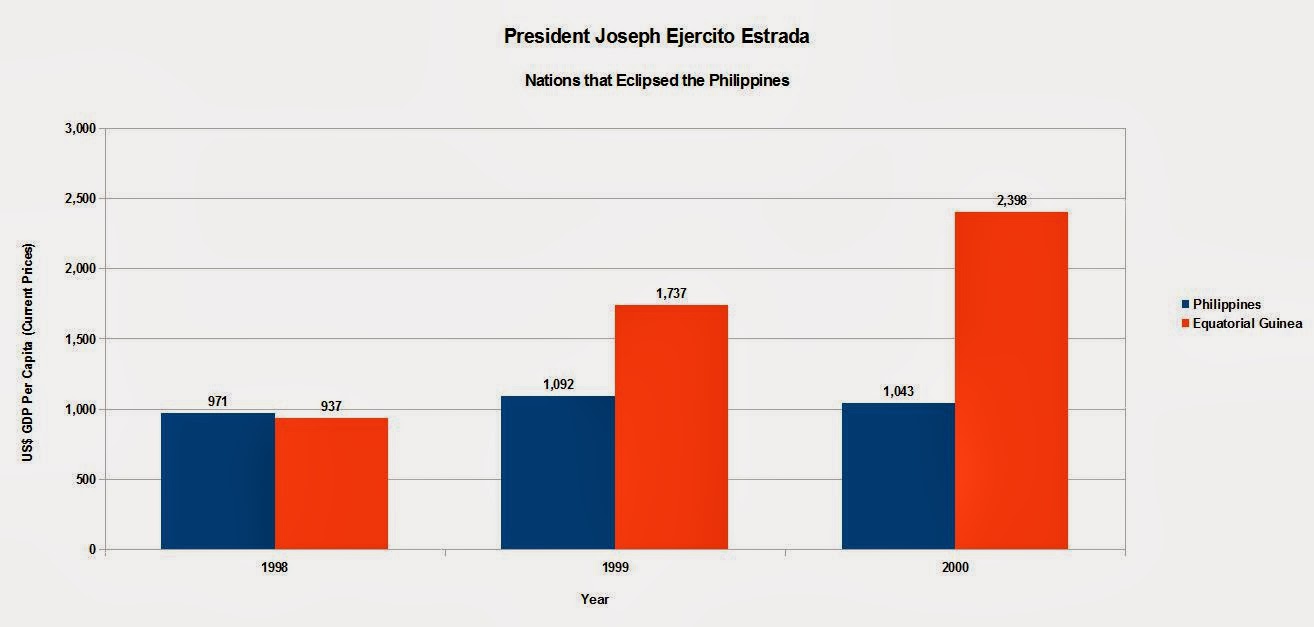
President Joseph Ejercito Estrada

Despite being ousted for corruption in 2001, President Estrada's economic tenure was at par with his predecessor Ramos, at least in terms of per capita GDP growth rates (1.28% CAGR), during his short tenure as our nation's President.

During his abbreviated term, one nation overtook the Philippines in terms of nominal GDP per capita: Equatorial Guinea (1999).


In terms of constant 2005 US $ GDP per capita, it was China (1999).


China is a special case, it has grown so fast in such a short time.  In 1961, its nominal GDP per capita was $76, while Philippines nominal GDP per capita, at $267, was 3.5 times larger.  For a long time, the thought that China could catch up with the Philippines was utterly inconceivable.  Today, China's nominal GDP per capita stands at $6,091 - 2.35 times the Philippines nominal GDP per capita of $2,587!


President Gloria Macagal Arroyo

At a per capita GDP CAGR of 3.07% (in constant 2005 US $), GMA's economic performance was more than 70% better than her dad's economic performance of 1.78% CAGR and more than double that of her dad's four successors.

Still, four other nations fared much better and overtook the Philippines in terms of nominal GDP per capita during her ten-year administration:

  1. Indonesia (2003)
  2. Republic of Congo (2003)
  3. Angola (2004)
  4. Sri Lanka (2005)


In terms of constant 2005 US $ GDP per capita, three other nations surpassed the Philippines:

  1. Armenia (2002)
  2. Bhutan (2002)
  3. Sri Lanka (2002)


President Benigno Aquino III

At a CAGR of 3.42%, Noynoy or PNoy's economic performance in terms of GDP per capita growth rates ranks the highest among all his six predecessor's, including that of his mother's.

 Mongolia, it turns out, grew much faster, overtaking the Philippines in 2010 in nominal terms and in 2011 in constant terms.


The Future:

President Benigno Aquino III: 2013 to 2016

Under PNoy, the country has been growing at a rapid clip and exhibited one of the best economic performances in the ASEAN region in 2013.

But other countries are growing much, much faster and are projected to surpass the Philippines by the end of his term in 2016.  In nominal terms, these countries are:

  1. Bolivia (2013)
  2. Papua New Guinea (2015)


In constant GDP per capita terms, no other countries are expected to surpass the Philippines.


President Jejomar Binay?

Who knows who will become President in 2016?  If history is any guide, Binay, as VP, will take over from Noynoy in 2016, just as Erap did from Ramos in 1998.

Nevertheless, our country is locked in a certain growth trajectory.  And if that growth trajectory holds, two other countries will overtake the Philippines in terms of nominal GDP per capita:

  1. Uzbekistan (2019)
  2. Vietnam (2022)
Yes, Vietnam, our bombed-out ASEAN rival, that only emerged from a debilitating war with the United States in 1975, could overtake the Philippines in nominal GDP per capita terms by 2022!


In constant 2005 US $ GDP per capita, no other country is expected to overtake the Philippines during Binay's (or whoever the next President is) term.


President Kris Aquino?

Projecting way, way into the future is definitely a crap shoot.  And who knows who will be President past Binay, if Binay ever gets elected.  Given our voter's penchant for name recognition, it wouldn't be surprising to see another familiar name as the top honcho of the country.  After all, we've already had two repeats in the last 52 years.  So Kris Aquino is my best bet.

But at our country's current economic path of growth, another bombed-out war-torn ASEAN neighbor will surpass us, at least in nominal terms, by 2024: LAO PDR


Which brings us back to India.  If current economic growth rates hold, even India will surpass us in terms of constant GDP per capita, by 2027.


Source: Worldbank.org